From Legal Text to Legal Intelligence
See how Descrybe turns primary law into information that research tools can search, connect, and return.
You will understand what goes into Descrybe, what is added during processing, and why the original legal sources still matter.
The short version
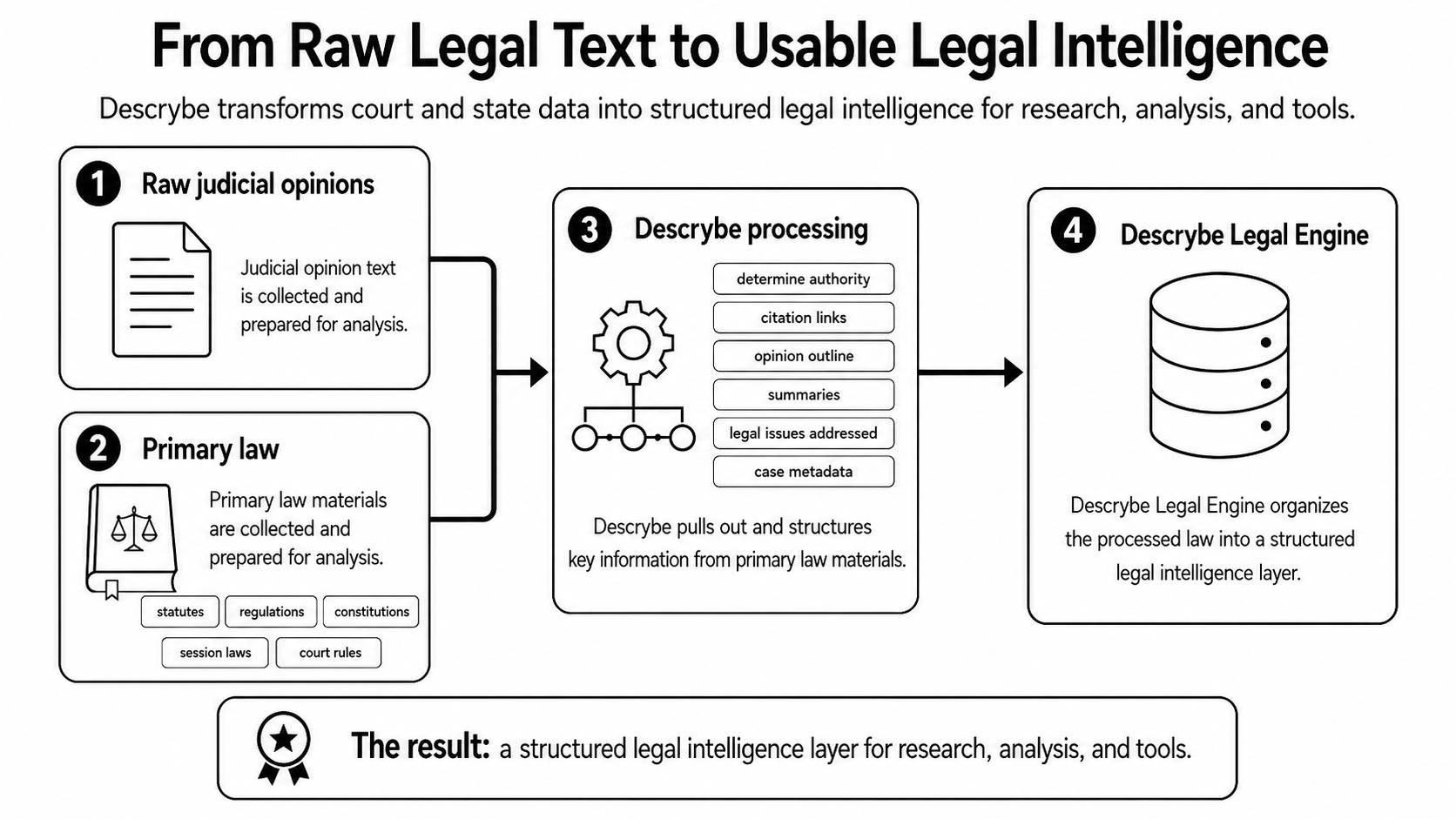
Descrybe starts with legal source material such as judicial opinions, statutes, regulations, constitutions, session laws, and court rules. It prepares that material for research, then adds useful structure around it.
The result is a legal intelligence layer that can help people and software find relevant law, follow citations, retrieve case details, and get back to the underlying sources.
What goes in
Legal information arrives in many forms. A judicial opinion may be a long document with citations, procedural history, quoted material, footnotes, and separate opinions. Statutes and rules may be divided across titles, chapters, sections, and amendments.
Before that material is useful in a research system, it has to be collected from known sources, cleaned up, divided into workable parts, and tied to identifying information such as the court, date, jurisdiction, citation, or document type.
That preparation does not change the law. It makes the material easier to organize and use.
What Descrybe adds
Descrybe pulls useful information out of the source material and connects related pieces. For cases, that can include citations, case metadata, opinion structure, summaries, legal issues, and signals that help a researcher understand how one authority relates to another.
For statutes, regulations, constitutions, session laws, and court rules, structure helps the system keep sections, headings, jurisdictions, document types, and source links in the right place.
The source text is still there. The added structure gives research tools more useful ways to find and return it.
- Citation links help connect cases and other authorities.
- Case metadata identifies details such as the court, date, and citation.
- Opinion structure helps separate the parts of a judicial decision.
- Summaries and legal issues provide useful starting points for research.
- Source links preserve a path back to the underlying legal material.
Search built around legal importance, not just similar words
Descrybe does substantial processing to make opinions and laws genuinely searchable. The system works with legal meaning and structure that Descrybe has already identified instead of relying only on exact keywords or placing a generic semantic search on top of raw documents.
For case law, Descrybe also uses court, jurisdiction, citation relationships, treatment, and other authority signals to help bring the most important cases forward. A case does not have to repeat the words in a question to matter, and a case that sounds similar is not necessarily the authority a researcher should rely on.
Authority is part of the search itself, not merely something checked after a list of results appears. That can surface important cases that a basic keyword or semantic search might rank poorly or leave out altogether.
For statutes, regulations, constitutions, session laws, and court rules, Descrybe can search across legal meaning while keeping the source hierarchy, jurisdiction, document type, and section structure in view.
The exact processing and ranking methods are part of Descrybe’s internal system. What matters to the researcher is a result set shaped around the law, not just around similar words.
What comes out
Descrybe Legal Engine organizes the processed material into a structured legal intelligence layer. Search tools, AI assistants, and applications built with the Open Connector can ask that layer for focused legal information instead of treating every source as one undifferentiated block of text.
A tool might search for cases about a legal issue, find a law or rule, resolve a citation, retrieve case details, check quoted language, or return passages for a person to review.
Structure helps, but it is not the final word
Organizing legal material makes research faster and easier to inspect. It does not turn every search result, summary, or relationship into a legal conclusion.
Important work still belongs to the researcher: reading the relevant authority, checking the jurisdiction and posture, confirming quoted language, reviewing later treatment, and deciding whether a source actually supports the point at hand.